Sunday, March 16, 2014

The Fallen Knight

In a dry patch of earth... the only dry earth in this field of rain, blood and urine soaked mud and misery, lies a gentleman. As the sky breaks into the fading light of dusk, the softly dying light shines against his plate. What plate that hasn't been soiled in the sopping foulness of battle. He is still, as they all are at that stage. His hammered metal shell does not move, neither does the the dark, bloody cloth of his padded garments beneath. He is still, so completely still that he is most certainly dead. His cratered helm and the cracked skull beneath are most certainly what fell him.

Death, or at least life in its very final stages, is a strange thing. He lays there, as they all lay there, on that fouled ground totally still. Still as stones in night's blackness. He makes no sound. His chest does not expand with breath. His mouth, choked with the blood that leaks from the orifices of his inner head does not tremble or close. It just hangs open in a sad, soundless cry. And yet, as you pass him slowly and even admire his armor, you notice that his eyes - shrouded in the shadow of his visor and the blackish brown of dried blood - watch you. They lock with yours as you move slowly above him.

You cannot see the color of those eyes, nor make their shape. But you can see the fading light in them... the fading flame of his life in them. He was young, and strong, and intense. His now still legs were strong and quick, and his shoulders hardy enough to control his war horse. He was not a wealthy man, nor a poor one. He is the son of a landed family. His fate, and his fortunes, and his understanding of himself was tied to the land. The rolling piedmont and forests of the pastoral north country. He was probably married, to a right fair lady of a quiet temper and a Christian heart. He loved, as even a pauper or prince would. You can see it in his face. His heart was not an evil one, and for as much blood as he could shed, he would not have otherwise. If he could have had if any other way, his life would have carried on. The quite life of a shire Knight; tending the estate, hunting boar and buck, siring as many children as his goodly wife could bare, filling his belly with wine, receiving communion, growing old with the seasons.

But here is where his song will end. He lies broken beneath his plate, unable to speak, or to pray. His hand is locked around his sword, though the stench of excrement is sure sign that he has no feeling his body. A grim and saddened priest performs one final blessing on him. He is sure to die, if not now then later, probably at the hands of a merciful archer who will put him out... and then take what he carry. He may last the night in his silence. Waiting to finally fade away. To be taken by the divinity and finality of God's plan.

As you move away, you wonder who he was, and what his life had truly been. To whom his heart had truly belonged. You wonder when he will finally pass into death. You swallow the bitter tragedy of knowing that his time had not ended by God's plan... it had ended by misfortune. The misfortune of his time, of his birth and of his station.

...You feel his eyes turn from you to gaze into heaven and ponder the same things.

Sunday, March 9, 2014

Making Lists: Disappointing Movies with So Much Potential

Some films, like "Mean Streets" or "Dawn of the Dead" or "Chimes at Midnight" have that special alchemical mix that leaves little to be desired. They live up to their hype. They meet all your hopes for them. At least, that's the case for moi. There are some films, however, that simply don't deliver of their promises and one is left with the feeling of really wanting to love them, but simply cannot do so honestly.

I have carefully and painstakingly compiled a list of such films. And because I am NOT a chooch who makes claims that he can't back-up, I will also explain my reasons for why they disappoint.

1.) The Keep (1983)

If there was one filmmaker who defined the 1980's, it was Michael Mann. "Thief" (1981), "Manhunter" (1986), "Miami Vice" (1984-1990) and "Crime Story" (1986-1988) painted a neon and black, pulp underworld of lurid affairs, blood money and obsession driven to electronic toccatas and vivid images.

His second feature film, "The Keep" takes that world and drops it onto World War II. The film centers around a German regiment discovering a great evil in a Romanian castle. An SS Officer (played by Gabriel Byrne) denies it. A persecuted scholar (played by Ian McKellan) seeks to harness it. And a stranger (played by Scott Glenn) seeks to destroy it.

The film looks very good. The visuals are pure Michael Mann, and the ambient soundtrack by Tangerine Dream puts us into the surreal and dark mood of the picture. The sets are surreal and immense, going beyond the realm of any WWII genre film and into the realm of fantasy. Mann's film is a world of parallel angles, grim colors and ethical inversion. The film often feels almost like a journey into the mind of a Nazi. Often it seems like a film that you must feel more than watch to understand. You crawl into it and get lost in its depths.

There are, however, glaring and profound faults with the film. Originally, the film was roughly three-hours-long, the most widely seen version of the film, the video version, was ninety minutes. There are no DVD versions of the film that I know of, and Mann has long since disowned "The Keep". You can omit it from your resume, but IMDb is an all seeing eye. The version I saw, on Netflix, was the shorter version. The plot and the film's theme are nearly impossible to understand as almost all of the exposition beyond whispered conversation between characters is lost to video editing. One gets the feeling that Mann had intended for "The Keep" to explore deeper, more profound themes about power, ideology and faith, but the extensive editing has left us with a run-of-the-mill horror/war/action film. The film's cast, despite being consummate actors, give hammy performances more at home in a Roger Corman film, rather than an A-List film by an A-List director.

Despite what I enjoyed about the film, I was left with the conclusion that "The Keep" was ultimately style with no substance. A strange and unbalanced mix of "Force 10 from Navarone", "Dracula", "Raiders of the Lost Ark" and "The Wall".

2.) The Good Son (1993)

20th Century Fox loves a box office film. The two big films of the time were "Home Alone" and "The Silence of the Lambs". Their idea: let's combine the two. The end result is 1993's "The Good Son".

11-year-old, Mark Evans (played by future hobbit, Elijah Wood) has lost his mother to cancer. When his father must go away on a business trip, Mark is left with his Uncle and Aunt in a picturesque Maine town. At first, Mark enjoys his temporary home and the company of his cousin, Henry (played by then box office draw, Macaulay Culkin). Soon, however, Mark discovers that his cousin has a VERY dark side.

"The Good Son" is not a bad movie. Not by any means. It is a very watchable movie, at least in my opinion. The film was well shot and well edited, not breaking any new round, but certainly a clean audio and visual experience. Elijah Wood's performance as a boy haunted by his experiences was very good (especially for a kid) and Macaulay Culkin's performance as the psychopathic cousin was sufficiently dark. The film really worked well in its depiction of childhood... or, at least childhood before the internet. The kids are not lily white little scamps that break a window by accident and then feel bad about it. No, they break windows because it's fun and kids like to have fun and get into trouble. Why, because kids don't understand the consequences. They are, after-all, children. And "The Good Son" depicts that convincingly. There is a light side and a dark side to childhood.

Initially, "The Good Son" had a deeper and more complex script (according the IMDb). And there are definitely signs of that throughout the film. It starts to explore concepts of loss, grief, parent-child relationships, and the nature of evil only to leave them too quickly and dive back into suspense. The end result is a superficial exploration full of exposition and very well crafted writing that seems incomplete. One reason for this may have been Macaulay Culkin's domineering father whose political power in Hollywood (thanks in no small part to his son), meant that he was often able to dictate the direction of projects starring his son. If a writer or director resisted or protested (as was the case of this picture) they would be replaced. The end result, a very non-mainstream concept trying to be mainstream.

"The Good Son" was a film that, at least to me, had a lot going for it. Yes, the concept of a child psychopath is hard territory to explore, but it could have been worth it. This picture seemed to have more things to say and more depths to explore. Unfortunately, what we're left with is mainstream fare. A potentially important movie, hobbled by a studio into an unimportant one.

3.) The Departed (2006)

If you've read my post about "Mean Streets" (if you haven't, you should), you'll know that I am a fan of Martin Scorsese's work, particularly from the earlier leg of his career. But I am no fanboy. As much as I loved "Mean Streets", "Alice Doesn't Live Here Anymore", "The Last Temptation of Christ" and "Casino", I am seasoned enough to know when a master just isn't delivering. As such is the case with "The Departed".

"The Departed" is a remake of a Hong Kong film about two cops; one, a good-guy undercover as a bad guy, and the other, a bad guy undercover as a good guy. In the case of this film, it is Leonardo DiCaprio as Billy Costigan (Good Guy), and Matt Damon as Collin Sullivan (Bad Guy), entangled in the web of Boston crime boss, Frank Costello (played by Jack Nicholson). Also rounding-out the all star cast is Mark Wahlberg, Alec Baldwin and Vera Farmiga.

I preface with this (probably going to be unpopular) critique by conceding that "The Departed", like ALL Scorsese films, no matter how poorly realized, is a well made film. It is energetic, it is visceral, it is funny, it is dark and it is extremely watchable, again and again. Scorsese and his team are such storytellers and such craftsmen, that even their mediocre work outshines that of most others.
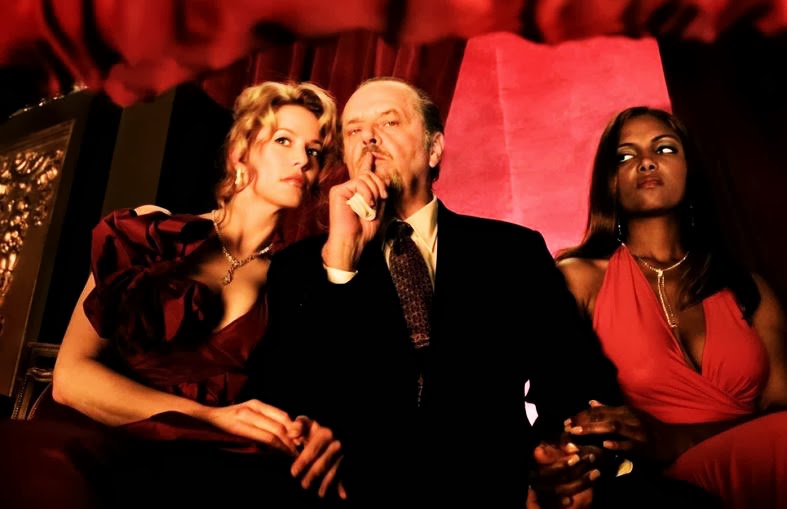
The explicit themes of the film explore deceit, crime, and loyalty. Some implicit themes explore the father-and-son relationship, absence of belief, and the idea of getting in so deep, that you become the thing you are sworn to defeat. In short, typical undercover cop fare,( e.g. "Donnie Brasco", "Rush", "Prince of the City"). Now, there's nothing wrong with typical cop fare. I enjoy typical cop fare... when it's done right. But this movie should have been more than that. Watching this movie, I feel as if Scorsese sacrificed substance for speed and exploration for energy. And though it was not a bad movie, I feel as though it took cheap and easy routes towards it final point. It took what should have been a world of grey, and turned-up the contrast to black-and-white. The good guys are definitely good, and the bad guys are definitely bad. It ultimately reduces down to an opera of rock music, blood lust and dichotomy (this is/that isn't).

The film is based, very heavily on the true case of "Whitey" Bulger. A Boston area crime boss who was able to infiltrate the FBI, acting as a mole while simultaneously gaining a blood-soaked grip of the area's underworld. I honestly feel as if this is the film Scorsese SHOULD have made. The story he should have told, with all of its complexities and murky depths. The story of an FBI agent who is corrupted, the man who corrupted him, and the agents who brought them both down.

For all of its good, bad, and ugly, "The Departed" (a film that won Scorsese an award), ultimately boils down to a perverted version of "Infernal Affairs" with a Southie accent.


Tuesday, December 17, 2013

The Inner Loneliness

It was so real... so tangible. She could feel the cool air on her face, the bitter breezes that blew through the woods mussed her hair, the sweat in her armpits, the pinch of the calluses on her feet. Tall, skeletal trees lined the straight path she walked like a church's nave. The the long, decrepit figures reaching-up to the amber sky like vertical pillars of ink.

No squirrels scurried, no birds sang, no stray cat searched-out a meal in the trash bin. She took slow, labored steps, looking to the ground and the shimmer of light on her boots. She hoped for someone, anyone to walk her way, to cross her path, to acknowledge her presence.

She yearned for the one she watched across a room, who she waited for in darkened corridors, who she saw in thoughts before the darkness of night embraced her. If only a friend, at least a friend. At least somebody to talk to, to share moments of living time with.

Nobody appeared, in those darkened halls or in the lonely cathedral of the forest. And so she continued-on, waiting and laboring every step.

Sunday, September 15, 2013

Late Laments

It's another of those long, lonely nights. They tick-on, one after another. The epilogues of the steady succession of wasted, lonely days. The days haven't been the same since then - since the skies darkened and black, moonlit water rose.

They haven't been the same since then. They were never happy, but at least they could hold a good mood for a while... say a day. Since then, every day has been a struggle. A trudge through shit, blood and garbage. A long, lonely march through an empty land. The sun pops-out and then disappears as quickly as it broke through... usually quicker. There's not much left to say about the state of things; whether in this life or another. It's usually easier to say nothing.

Why do what you're not content to do? Why toil at a labor of pain and not at a labor of love? How can you relate to people when you simply cannot understand them? How do you tune-in when your frequency is different? How does a fox live in a lion's den? How do you face a world that you're petrified of? How do you get guided into something so against your nature... how do you get out?

Saturday, September 14, 2013

Tom G Reviews: Dawn of the Dead

In 1968, George A. Romero, a film student from Pittsburgh, Pennsylvania, made a low budget horror film about a group of people stranded after escaping a horde of zombies. Made on an ad hoc budget with the help of friends and neighbors (including a butcher), "Night of the Living Dead" was an unsettling, stark and darkly humorous commentary on the goings-on of the late 1960's. The darkly relevant film became an instant classic, an iconic horror film and THE iconic zombie picture. With "Night of the Living Dead", the Steel City film student with something to say single-handedly started a movie genre; the zombie movie.

Ten-years-later, Romero returned to the genre he created with another dark, violent and saucy look at the state of American society with "Dawn of the Dead" (1978). Although still an independent film, Romero had a larger budget to work with, the talents of special effects virtuoso Tom Savini, and the Monroeville Mall outside of Pittsburgh to use at night. The result was another landmark zombie picture loaded and wet with thrills, dark humor, action, commentary and some of the most glorious gore of the 1970's.

The plot is fairly straight forward. As the world devolves into a zombie-infested bedlam devoid of law or order, Philadelphia television studio employee Francine (Gaylen Ross) and her boyfriend, TV helicopter pilot Stephen (David Emge) steal the station's helicopter in an attempt to escape the doomed city. Philly SWAT team members Peter and Roger (Ken Foree and Scott Reiniger) meet after a brutal and chaotic raid on a zombie-infested Housing Project. Armed and disillusioned, they, like Fran and Stephen, decide to make a run for it. The two pairs meet and decide to team-up, finding strength in numbers and SWAT guns. After crossing Pennsylvania, they end-up finding refuge in a huge, powered, watered, and well stocked shopping mall. After clearing the mall of its plethora of zombies (former shoppers as one would conclude) and losing a teammate, the group do what anybody would do if they were locked in the mall alone and without law... they loot it. Eventually the elation of raw and unadulterated taking and amassing wears-off, and another round of disillusion sets in. Before the survivors can move on, the mall is discovered by a marauding horde of bikers led by a machete-wielding leader (played by Tom Savini) who crash the tranquil cloister of this shopper's paradise. The film ends with a final battle between the survivors, the bikers, and the zombies.


"Dawn of the Dead" is not a "shock horror" movie. There are no surprises around the corner, no jump scares, and the zombies themselves are by no means scary or intimidating. If anything, Romero's zombies are stupid and even comical. No, "Dawn of the Dead" is more along the lines of "action horror". It's packed with all the gunmanship, running, looting, blood, guts, and dark comedy that a zombie movie fan's heart can desire. It's fun, just a lot of fun to watch. Not to mention, dates well for a 1970's zombie picture.

"Dawn of the Dead" is one of the best scored movies I've ever seen, personally. Even the incidental music is just a delight to the ear that creates the right mood; weather it's funny, sad, horrific, chaotic, and so on. The soundtrack was provided, in part, by the Italian Prog-Rock band, Goblin (who have also done scores for Dario Argento, whose work was influenced by Romero's).

The real sales-point of "Dawn of the Dead" is its gore effects provided by Tom Savini. What can you say about Tom Savini? He is a virtuoso in his field, perhaps THE virtuoso of practical special effects. While Dick Smith is the master who made special effects an art form, Tom Savini is the virtuoso who can make even the most stomach-churning gore a thing of pure and earthly beauty. "Dawn of the Dead" is the movie that ushered  in the gore movie. Every slasher flick, every gore-crazy Italian horror movie you've ever seen post-1978 owes itself to Tom Savini's work on "Dawn of the Dead".

If George Romero proves one thing with any of his pictures, it's that he's right where it's at. "Dawn of the Dead" carries on the tradition of "Night of the Living Dead" in that it's more than just a zombie movie. It's more than just blood and guts. "Dawn of the Dead" is commentary. Why do the zombies come to the mall? Because it's where they came when they were living. The store is where everything comes from. Creatures of habit go where the food is, no? The zombies in "Dawn of the Dead" are not only stupid; they're clumsy, habitual, like sheep. They follow the other zombies, even to certain death, because it's all they know. Romero's zombies are a mirror on modern man. The only difference: they can't use a gun.

No, the guns are used by the "living". They use them to kill zombies, to survive. When the living break though, they loot, and they loot, and they loot some more. It's all for the taking, so why not take it. The living even use their guns to defend their loot. It's theirs, and entirely theirs because they found it.

The chaos, consumerism, and human madness that "Dawn of the Dead" portrays is as relevant as ever. If "Night of the Living Dead" reflected the changing society of 1960's, then "Dawn of the Dead" reflects the "fuck you" society of the 1970's. The violent, reactionary racism of the SWAT raid. The "every man for himself" chaos of the TV studio. The hicks hunting zombies, once their friends and loved ones, for sport. The material paradise of the mall. And finally, the crazed and callous bikers throwing pies and looting even the most arbitrary goods. "Dawn of the Dead" reflects a nation ever more extreme, ever more contentious, ever more materialistic, ever more exhausting, and ever emptier. A society deprived, depraved, diseased and dissolute. Romero is looking through his lens at modern America.

"Dawn of the Dead" is a must see for any horror fan and any cinephile. It is the consummate zombie movie. It's gore effects, audio, visuals, and relevancy were game changers. Every zombie movie since owes its existence to this picture. At least that's my opinion.


 of people

Saturday, August 17, 2013

Old Snow

He was standing on his stoop, looking-out over his street. The air was low and frigid, the sky began to turn pink as the sun set. Winter in the Northeast is bitterly cold and mercilessly wet. It's a nice day when the sun shines... even if it is thirty-one degrees. The moist cold cut through his trench coat and into every part of him. But he was fine, more-or-less, so long as he had a cigarette and the sky was pretty. Standing there, on his stoop, having a smoke after a long day, he began to acquiesce to his thoughts.

So many winters had come and gone. Every year it grew cold, again and again. The years were beginning to pile-up. Like forsaken junk in the yard. Rusted odds and ends. Here today, gone tomorrow. Where were the years going? He lost a little more every year... then a little more... then a little more. Year-after-year, he lost a little more but fell into something else. A little youth for age. A few dreams for wisdom. Some faith for knowledge. Passion for comfort. Was the trade worth it? He didn't know, but he mulled-over a response.

Years ago, winter was a positive thing, or... at least... not so complicated. A good snowfall was a blessing, not a challenge. Snow was great when it was nice, wet and heavy. Good for making snow balls. Nice hard ones, too. The kind that make a "thud" when they hit. A kid could take a beating after it snowed. Especially down here, where the snow was always wet and the kids were particularly vicious. It was training... it tempered them against the world. Hard, brutal, good ol' American violence. It was fun... of course... especially to pitiless children who knew enough, even at that young age, to focus on the smallest and the weakest. Then somebody would get hurt and everyone would just go home or find another battle. Little mercenaries, damn the consequences, just find another one to get your kicks off. It was a "fuck-you" attitude that was common in these parts. It was something for adults who didn't even own their own homes to pass-down to their kids.

At the end of the day, he would be alone, still sore and certainly tired, but still young and thick-blooded enough to not freeze. The sunset seemed magical. The soft, warm pastel sky fading into the smog over the horizon. The ambient roar of the highway filled the wet, bitter air, the tire tracks froze into dazzling patterns in the muddy slush.

The world seemed smaller now, and his blood with thinner now, and the insulation of childhood was gone now. He needed a coat not to freeze, a cigarette to quell his nerves and a cup of coffee to get his motor running. The sunset had dipped into a cold, dark blue as grimy street lights popped-on. His cigarette was long done and he was growing colder and colder. Time to go in, time to rest.

Saturday, August 3, 2013

Tom G Reviews: Mean Streets

Over the years, I've seen a lot of movies... A LOT of movies. Some have been decent, most terrible, and a few good. But a handful have been truly thought provoking, mentally stimulating works of art. Martin Scorsese's 1973 feature, "Mean Streets" is one of those. Aside from being one of my favorite films, "Mean Streets" is a confluence of talents, style, writing, and production that serve as a benchmark in the medium.

Originally titled "Season of the Witch", Mean Streets was written over the course of several years by Martin Scorsese and Mardik Martin. Like its precursor film, "Who's that Knocking at My Door", Mean Streets is somewhat a documentary about a young Scorsese, the Lower Manhattan neighborhood he grew-up in, and ultimately working-class neighborhoods in general.

After making his first budget-film, "Boxcar Bertha" (1971) for B-Movie producer, Roger Corman, Scorsese was encouraged to do a project close to his heart... a labor of love. Corman initially offered to finance the film, but only on the condition that the entire cast be black. At a time when films like "Super Fly" and "Coffey" were major box-office earners, the King of Exploitation's offer was not as outlandish at it might seem, nor was the fact the Scorsese considered it. Ultimately, Scorsese turned-down the offer and "Mean Streets" was made on a budget of roughly $500,000, a paltry sum for a film, even in the early 1970's.

"Mean Streets" revolves around Charlie Cappa (played brilliantly by Harvey Keitel), a Little Italy local and protege of his Mafia Capo uncle, Giovanni (played by Cesare Danova). His life consists of collecting debts for his uncle, hanging-out at "Volpe's" a gin mill owned by his friend, Tony (played by David Proval), keeping his friend "Johnny Boy" Civello (played by Robert DeNiro) out of trouble, obsessing over a black stripper (Jeannie Bell), and carrying-on a clandestine affair with Johnny Boy's cousin, Teresa (Amy Robinson).

The conflict in the story is within Charlie himself. A devoutly Roman Catholic, Charlie fears the hell he knows surely awaits him, even to the point of masochistic self-inflicted pain. As a collector for his uncle, Charlie is promised ownership of a restaurant. The only problem, Charlie's gain will come at the cost of another man's debt to Giovanni. Charlie's Catholic guilt creates a compulsion in him to "save" others. One of those Charlie dedicates himself to "saving" is the volatile and possibly unhinged Johnny Boy who owes money all around, but most importantly to the wolfish and stone-like loan shark, Michael (played by Richard Romanus). Along with his taboo love affair with the epileptic Teresa, Charlie finds himself torn between loyalty to his friend, his lover, his career and his faith.

"Mean Streets" is not a simple story; it is reflective, gritty, uncompromising, dark, humorous, touching and heartbreaking. From the beginning, the audience is immersed in this story, these characters, this time, this place and its emotion. Martin Scorsese, showing the colors of an early master, introduces us to the time, place and characters using quick vignettes and by rolling fake Super 8 home movies over the opening credits. It looks authentic, it sounds authentic, it feels authentic. Scorsese creates a reality for us to invest in.

Scorsese's mobsters may be dressed nice, and even a bit of fun, but they are fundamentally petty, volatile and bleak. They are everything that movie mobsters aren't supposed to be... they're real. Scorsese's New York City isn't the romantic wonderland of "Manhattan" or the shining Oz of many films. The New York City Mean Streets inhabits is the NYC of the 1970's, the real deal. Grimy, graffitied, garish and garbage-strewn. Sex in Mean Streets is not romantic or lofty; it's funky, awkward and beautifully human. Violence in Mean Streets is not dramatic or epic; it's split-second and unsettling. War veterans are on edge, squeegee men wait at traffic lights, raucous parties rage in tenement apartments. No Sinatra, this is Rolling Stones territory. Mean Streets is the reaction to the Godfather.

Somehow, in all this sleaze and violence and urban disorder, Scorsese makes the audience feel right at home. It seems normal enough, even mundane. From the chaos of the San Gennaro Feast, to the crimson-soaked Saturday night at the bar, to the Italian eateries, the tenement apartments, building air shafts, the sub-level pool hall, the dark streets of the Lower East Side, the Churchyard, even the the rooftops; none of it feels like a movie. The dialogue is so real, so fast, so hard and so natural that it's hard to believe that any of it was ever scripted. The characters so natural, so unbalanced and so organic that the viewer gets fooled into believing that they're real people. The conflict and the tension is so palpable and relatable that the viewer finds him or her self becoming emotionally invested at times. The brawls, the arguments, the profanity-laced conversations are all a given. They fail to shock an audience that develops a normalcy and relationship with the story and its players.


The film, like virtually all of Martin Scorsese's pictures, is scored wall-to-wall with contemporary music. From pop to rock to Italian folk songs, one gets the impression that Scorsese designed the film's soundtrack from his own record collection. A fact that he has admitted it in several interviews. Now, scoring a film with popular music is tricky. In fact, in most films, one can argue that it doesn't generally work well. The tone of a song may match that of a scene, but the meaning of the song may not. Or, conversely, the lyrics may relate to the film, but the tone of the song itself can kill the mood of a scene. More often-than-not, however, it just comes-off as hackneyed and lazy. In Mean Streets, the music created the mood. It worked. Without fail.


The costumes of Mean Streets are too often overlooked. Though not truly "costumes", the clothes worn by our cast of low-brow Bowery boys are defined by the characters wearing them. Conflicted Charlie, is clad in the double-breasted, pin-striped suits of an Italian gangster when placating his uncle. Yet, he wears neutral-tones of beige and green when trying to defend Johnny Boy or soul searching with Teresa. Johnny Boy is the image of chaos in his leather jacket and mismatched get-ups. Tony, entirely in red, matches the sleazy danger of his saloon. Micheal in black, grey and white. Like stone, ice cold. Richard Romanus seems almost born to play that role, his face looks almost carved from granite; threatening even when splattered with cake.

Mean Streets is very much a film of its time. It reflects the 1970's. Its mood, its style, its subject matter. Martin Scorsese was of that generation inspired by the "New Wave" of European cinema in the previous decades. And that naturalism and cinematography certainly shows in Mean Streets. But Scorsese was also highly influenced by the gangster films of his youth. And that too shows, even in Charlie's pinstriped suits. In a way Mean Streets is very much an heir to the Pre-Code gangster pictures of Cagney and Muni. Mean Streets is as much "Little Caesar" as it is "Le Mepris".

Now, to be fair, which I will, Mean Streets did have some problems. As good as its plot was, Mean Streets seems to take side trips that, although well executed, lead nowhere. Scorsese introduces characters or seems to begin exploring ideas in the film that never get expanded-on or tied-up. Almost like random happenings in the movie's world. They just seem to happen for no real reason and in the end, Charlie has learned nothing from them, and neither have we. Just padding. These foibles, however, do not detract from the overall picture and are certainly not regrettable.

Mean Streets launched multiple careers and indeed changed the way films were conceptualized and executed. A product of an artistically open time, when being different was prized and being subversive was exulted, Mean Streets defined one generation and inspired another. It certainly inspires moi. For anyone who fancies themselves as a cinemaphile, Seeing "Mean Streets" isn't just recommended, it's required.