Sunday, April 9, 2017

Tom G Reads: Old School Monsters

I told Mr. Charles Joseph that I would review a chapbook that he half-wrote. But I’m a procrastinating prick and simply never got around to it as much as I wanted to. The dull, meaty tentacles of “I really should get that done” have been wrapped around my head ever since. So here it is, my first review of a chapbook.

            To those of you who don’t know what a chapbook is, I’ll explain quickly and to the best of my ability, that chapbooks have their roots in the penny pulp pamphlets sold by peddlers to an increasingly literate public before the dawn of the paperback novel and the newspaper. They were usually political rags or full of poetry, ballads, and parables. They were cheap and easy to read. The literature of the street. And even now, when they’re almost exclusively the territory of poets waiting for a payday, they still retain the quality of their roots. It’s a rough-hewn literary tradition of the none traditional.

            “Old School Monsters” written by Charles Joseph and John Dorsey features an introduction by Adrian Manning and shokushu goukan-esque cover art by Janne Karlsson. As its title might suggest, just about every title and piece within contains refence to the offbeat, eclectic B-films of matinees and midnight features seen in the late movies and seedy, ticket booth theaters of the bad old days.
            
            I’m not about to examine each and every poem –there are twelve– and I’m not prepared to pick-about nouns and sentence structure for the sake of a masturbatory exercise in literary analysis. I am, however, going opine about my own take on the objective item and its themes.

            “Old School Monsters” is a really good piece of work. Especially given the fact that it’s co-authored. The quality of my copy, at least, is fantastic. Published by Indigent Press, the tiny book’s construction is far above rag, and the cover art is luridly sinister and, frankly, top notch.
            
             Each piece in “Old School Monsters” makes reference to the movies mostly forgotten but always at home on Turner Classic Movies where we phony fifth-column snobs watch and analyze them for the sake of sex with the dolls of intellect and “culture”. However, each piece is more than a one-off about “Dracula”, “Angels with Dirty Faces”, “Creature from the Black Lagoon”, and so on. No… instead each piece is about life where the monsters and heroes are the same and the horror is the very real, very creepy banality of the passing year, the bad relationship, the death toll of a mostly forgotten war. The titles are even misleading in the best possible way. “Nosfaratu” leads us to maternal love, “Revenge of the Creature” puts us face-to-face with the most awkward thoughts in the cold heart of some no place in America, “Abbot and Costello Meet Cleopatra” reaffirms the cultural destitution of an Armenian Princess from Los Angeles, “Angels with Dirty Faces” –and I admit my bias for this one– pulls us into the chasm between old lions and young cubs.


            “Old School Monsters” has a disjointed, disorganized arraignment that I just can’t make-up-my-mind about. Is it an inclusion? Or is it perfect? As a sucker for harmony I feel bewildered reading it sequentially form cover-to-cover. But as one who has discovered the calamitous cacophony of life, I feel like it’s perfect. Reflection and ponder is one scattered mess of a mental exercise.

            To conclude, I will summarize my take on “Old School Monsters” by saying that it’s very well executed. It’s an enjoyable and rewarding read, especially when read more than once. A short burn with a long payoff. I would certainly recommend it. 

Wednesday, January 18, 2017

Plethora of Hint Fiction: Volume 1

Her Ladyship of the Condiments
It is evil deeds her heart breeds.
Sullied was the pickle she put back into the jar.

The Fight
It was at night.
They stirred through rooms.
Neither remembered how it started.
Only the mirror she broke.
And his hand across her face.

A Warm Home
She keeps the heat too high.
But she’s beautiful, and he loves her.
They made a good home.
Downstairs, the dog gingerly licks its balls.

A Cold Home
Mother never talks during breakfast.
Father only broods during dinner.
The kids only play when they’re alone.
The parakeet paces in his cage. 


Grampa Dreams
Grampa sometimes dreamed.
            Mostly the past.
The dead German in Belgium.
            Whose boots he stole.
Grandma in 1951.
            She stayed warm in his CPO jacket.

Sweethearts on Parade
“Sweethearts on Parade” played.
The skating rink was dim.
Sandy drank an egg cream.
Charlie cocked his hat.
They pretended not to see each other.

1965
Johnny fell in love.
Cheesy hit a guy with a brick.
Billy stole Donna C’s panties.
Tony shot a cat.

Mushy caught the wrong slug. 

He Calls Himself an Artist
He calls himself an artist.
He toasts at Lady Liberty’s.
            And smokes her stuff.
He’s not about the work.
He’s about calling himself an artist.

Identity
She stopped acting, and gaffing, and weeping, and fearing.
She started just being.
The last week of her life.

Watching the Light Pass
He watched blades of grass blow. And saw the light pass from the eyes.
            Silent death bringer. He wiped the blood from his blade.

Lights in the Forest
            Yorkshire girl’s eyes witnessed lights in the forest without light. And the cur spoke senseless tidings. She said, frightfully, a rosary. What witchery be this?

The Narcissist’s Sunrise
The sun rises for them.
            That IS what they tell themselves.
They are the end result.
            It all culminates in them, right then, right there.

By Tom Gullstrand.
Use only by expressed permission. 

Saturday, December 31, 2016

Adieu to You, Twenty-Sixteen


            If nothing else, 2016 has been the year of the unexpected. The Chicago Cubs won the World Series after a 108-year losing streak. It was the year that the man who received fallatio from Marla Maples in the back of a helicopter 25 years ago, became President of the United States. It was a year that robbed us, like an assassin, of icon after icon and those we never thought were icons until they were gone. 2016 was a year that brought dread to optimists and idealists the world over, and served us coldblooded cynics exactly what we wanted… cold.
           
And vandalizing art museums would never be the same again.

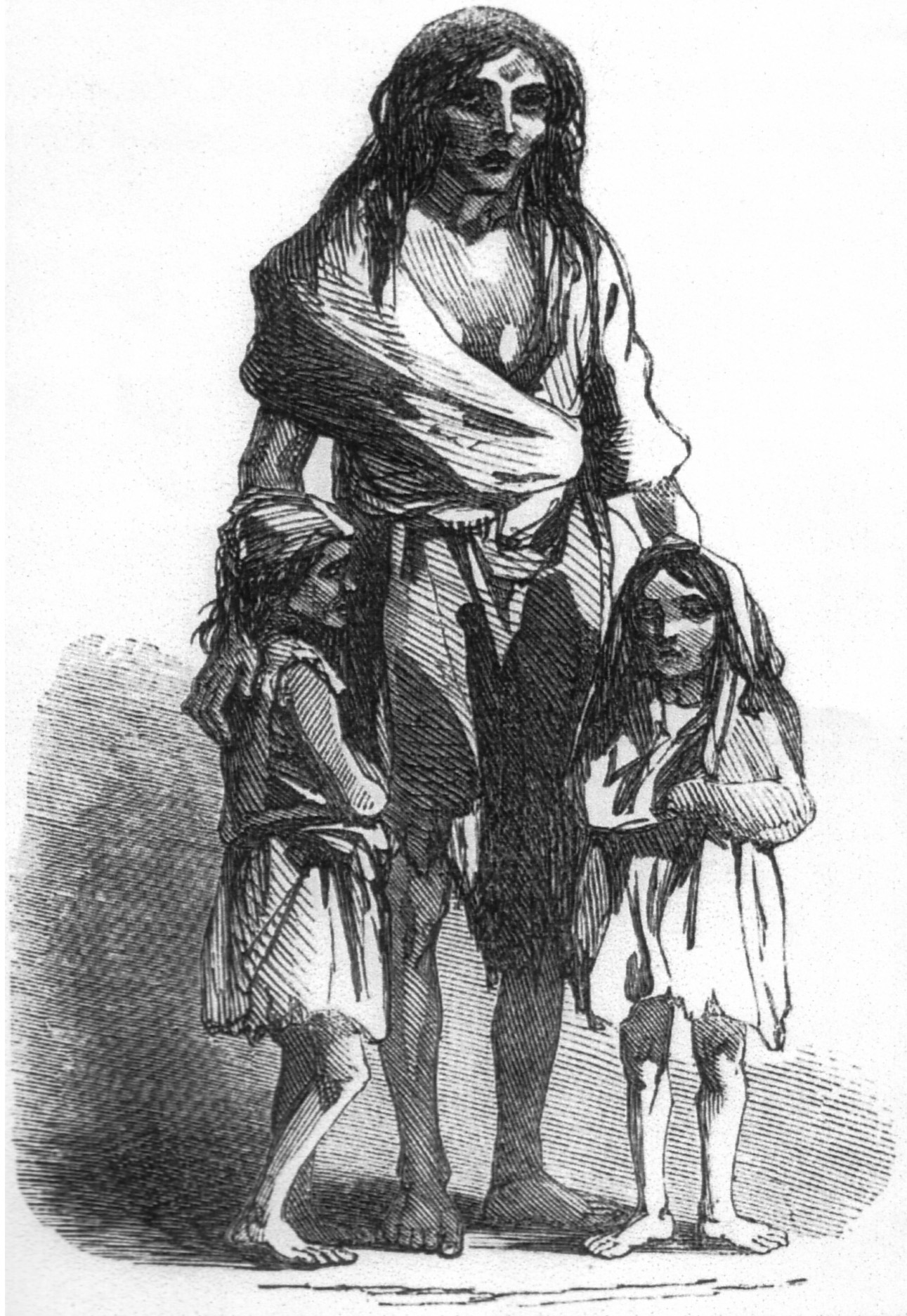
           2016 did, however, expose the truth. Truth that we usually bury under pleasantry and politeness if we behave ourselves. Truth that we mask in the vein of pretending to be tolerant and enlightened. The gift of 2016 is that we now know our own mettle. Many of us have learned that the we’re not measured by our wins or loses, but by how we accept them and carry on. We have not measured well. 2016 exposed the charlatans, the hucksters, the skunks, and the blowhards. And after all of the Twitter battles and Facebook skirmishes, and riots within the walls of YouTube, and desperate shrieks of pride and resentment at places like coffee shops and parks, and carnages big and small, we all get to glower bitterly at sodden, decaying potato fields like Irishmen who don’t know who to blame.

            The best thing you can say about 2016, is that we know who won… nobody.


We bid you Adieu, Twenty-Sixteen, and fond Bah Fangool. 

Monday, October 31, 2016

About Horror: The Power of Silence and Shadow


Few genres rely on audience stimulation like Horror. All genres seek to stimulate, but only two – Horror and Pornography – completely fail if they do not. While other genres can rely on their message and just good workmanship to communicate, horror is to be experienced. And that is because horror seeks to tap into the psyche, the soul, and raw sensory reaction more than any other. There lies the line between good horror and bad horror: good horror does this while bad horror does not.
            Most good horror on the screen is adapted from the page. And this goes all the back to the birth of the screen. From Mary Shelly’s “Frankenstein” to Bram Stoker’s “Dracula” all the way to William Peter Blatty’s “The Exorcist”, Stephen King’s “The Shining”, and Ira Levin’s “Rosemary’s Baby”, so many great and awful reiterations of horror come from the great writing that taps into our collective anxiety, trauma, and nature.
            That being said, books have the time, the space, and relatively small marketplace to work us over slowly and methodically. Unlike sight and sound, words on page serve only to communicate by way of the reader’s capacity to empathized, imagine, and analyze. It’s an intellectual medium. In that sense, it’s the highest.
            Writing, while important, relies on its audience for effectiveness. Only the interested and capable literate can experience words on a page.
            Films, however, are far reaching. Anyone – who is NOT staring at their friggin’ phone – can experience a film. While the terror and dread on page requires intellectual work, on the screen, most of the work is already done. Sit back, relax, and enjoy the trip. It’s a direct sender/receiver medium. Dread on the page is immersive, dread on the screen in unforgettable.
            That being said, over the course of my life, horror on film has almost completely lost its ability to truly effect its audience on any level deeper than the immediate reaction of screaming teenager girls with names like Katelyn, Kelly, and Kayla at the local Cineplex.
            It is a landscape of sudden twists, predictable plots, cheap sex, and jump-scares repeated again… and again… and again… and again.
            This degeneration has its roots in the decade before I was born. It was in the 1980’s that lurid sex, gruesome violence, and monsters that you always saw on screen were taken out of their home in the grindhouse theaters and made into mainstays of the film industry. In the quest for blockbuster openings, video rentals, and merchandizing the decade that began with Stanley Kubrick’s Rubik’s Cube adaptation of “The Shining” ended with “Friday the 13th Part VIII: Jason Takes Manhattan”. And while America’s jean-jacket wearing youth had a movie to rent while they ate Domino’s Pizza, horror films as a legitimate avenue for exploring our collective anxiety, trauma, and nature was permanently crippled.
            In this, and arguably long before this, was lost a most important element of horror: ambiguity.
            Today’s audience has no capacity to watch a long shot, listen to silence, or interpret a shadow. Instead, they rely on instant gratification and jump scares. For this reason, horror as genre, not only in film but in writing, is withering a long, slow death. My proof comes in the form of comments like, “The Exorcist is a comedy.” The idea of audience interpretation is mostly a lost one.
            But it’s in ambiguity that horror lives. Director William Friedkin has even stated that he purposely used silence, shadow, and stillness to disturb the audience in 1973’s “The Exorcist”. Few films capture their source material like “The Exorcist”. It is widely regarded as one of the most frightening and psychologically disturbing films ever made. Audience reactions when it was released included panic attacks, physical illness, and a rise in psychotherapy.
            While these reactions seem apocryphal, it was not scenes of head-spinning, vomit, or sacrilegious masturbation that affected audiences the most. It was the moments of silence, shots of shadow, and tense stillness that overwhelmed viewers.
            Friedkin has admitted to deliberately mixing the films audio to include dense quiet and even utter silence so that he could break with loud, brutal noise. He’s also admitted to using darkness and slow camera work to build an atmosphere of tenseness and abysmal mystery. In this way, he created a canvas for the audience to project the worst of their imaginations.
            Many horror films from the “Silent Era” do this too. Filmmakers with limited resources and almost no special effects created negative space, forcing audiences to project and interpret darkness.
            While F.W. Murnau’s “Nosferatu” may seem tame, the images on screen of almost entirely cast in shadow. Now, while this was probably a means of cutting production costs, it created an entirely unforgettable and hypnotizing film. In its time, it disturbed audiences. Blacken doorways and windows, dark rooms, and dream-like pacing built suspense and menace. The darkness became the villain, because the darkness could be anything a movie goer in 1921 imagined it as. In this way, “Nosfaratu” probably captures the spirit of the Bram Stoker’s novel better than any other version ever made.
            1999’s “The Blair Witch Project” was incredibly effective at horrifying and traumatizing its audience. In its claustrophobic setting, where the only horror that’s actually seen is the disintegration of a human group, the mostly unintentional minutes of utter blackness and shots of the deep, dark woods create a film that pulls us in and leaves us terrified of something that we never see or hear on screen. At least the first time we see it.

Horror is not boogeymen and bloodletters. True horror does not live outside the viewer, or the reader. Horror is within. Horror lives in silence and darkness. In the ambiguity of shadow, where perception is so distorted that we can’t see, sight turns inward towards the mind and the soul. It’s the demons we don’t see that are the most terrifying, the most clarifying, and often, the most liberating. 

Monday, August 29, 2016

He's been reading Kurt Vonnegut, again...

            Sleepy time… time to nod off… the moon like a perfect, glowing snowball in the sky – the kind of snowball you see in cartoons, but have never seen in real life.
            
            I was in the mall, on the second tier, in front of a Suncoast Video. I was painting a portrait of a pop music icon – I won’t mention her name – dressed like a Valkyrie. She posed in front of me with a glowing smile on her face as she blew bubbles. All my equipment was in perfect order. My brushes stayed clean, my thinner clear, and my paint wet.
            On the audio system played The Andrew Sisters in a loop, again and again… and again.
            Down on the level below, between a Disney Store, an H&M, and a Sunglass Hut, Waffen SS troopers ate Panera Bread and tested their machine guns on men with Watermelons for heads. Their Commandant would then use the slaughtered watermelons to make daiquiris.
            Every few minutes, the TATATATATBROO of their Sturmgewehrs would ring-out followed by the grinding chainsaw buzz of a Magic Bullet blender. I could look and see the spatter of melon and seeds on a wall.
            “How ees zeh Masterpiece coming too, now?” asked the Commandant.
            “Good. We’re getting there,” I answered.
            “Have unt daiquiri?”
            “No thanks… I think I’ll pass.”

            A hot air balloon passed over us all. In it was a Southern Belle dressed like Glinda the Good Witch. She waved at us like a beauty queen. The SS men below waved back and blew her kisses. She farted, and her gas came-out in an immiserating rancid smelling cloud of rainbows and sparkles. My model blew some more bubbles, then reached-out so that a Bald Eagle could land on her arm. Herr Commandant sang along to “Johnny Fedora and Alice Blue Bonnet”.

            Soon, Herr Commandant spoke-out with fear and fury, “Ve have run aut of zeh melons!”
            The SS troopers took aim at Beauty the Queen in her smelly, smelly balloon and began to fire. TATATATATATATATATBROO shook the air. My model stayed still and smiled. The balloon exploded into fire and black smoke and a rain of peanut M&M’s. To this, Herr Commandant had one lament.
            “NEIN! Zeese ist no good! Ve are allergic to nuts!”
            My model finally spoke is a soft, gentle voice, “Lucky them, they get to be the face of evil, they’ll never need to top themselves. Let then try being famous, I have to top myself every time.”

            In the Men’s Department at JC Penney’s, Ron Howard edited a movie version of what had just happened in Dress Shirts while Tom Hanks recorded the narration near the Levi’s.
            In the Women’s Section, Dr. Phil taped a show with Adolf Hitler. The Fuhrer was in tears.
            “Now Adolf, I don’t ask WHY you do what you do. I ask why wouldn’t you. Now, I’m gonna put some verbs in my sentences…” said Dr. Phil. An audience of women slowly nodded.
            In shoes, Barack Obama, Bernie Sanders, and Alex Jones played Pokemon Go.
            An Islamic radical perused in fragrances while licking one of those giant lollipops… you know the kind. A salesgirl sprayed him in the face with a Calvin Klein fragrance. A drone with Hillary Clinton’s face slowly floated through the doors. It hovered for a bit, then squealed loud beeps before lowering a minigun that thunderously fired with such ferocity that it shredded not only him, but the poor salesgirl into a fine mush.
            Hillary and Bill walked in and smeared the mush on dry bread with capers. As they indulged, a rabble followed them in. They were, of course, PETA people.
            “MEAT IS MURDER, MAN!” they shouted.
            “Hey… you have to enjoy the fruits of victory,” argued Bill Clinton.
            “DAMMIT!” griped Hillary as she used a remote control to aim the drone at them.
            Another squeal of beeps, another thunderous clatter of fifty caliber shots and PETA was a pile of lettuce and organic dressing on the floor.
            “Bill, you need to eat some salad,” harped Hillary.
            “Aw, come on, baby.”
            Hillary just pointed, and Bill did as he was told.

            “SEE, I told you that they were cannibals!” bellowed Donald Trump in Juniors as he pelted a puppy dog with small rocks.
            In the parking lot, a mob of rainbow haired Social Justice Warrior gathered with signs and mega phones to watch a zeppelin burst into flame and crash to the earth in a hellish storm of immolation and screaming.
            “DEATH TO MICROAGRESSIONS!” they shouted. “WE ARE THE OPRRESSED! WE ARE THE OPPRESSED!” they went-on as Stormtroopers from Star Wars hacked into their smartphones and read their playlists.
            “Corporations are evil! DOWN WITH MONSANTO! DOWN WITH CORPORATE AMERICA!” tweeted Bernie Sanders on an iPhone of all things.
           
            A beautiful lady I know emerged from the darkness. It was the greatest feeling of relief I can remember ever feeling.
            “Some crowd,” she sighed.
            “Yeah… really.”
            “Why do they hate that zeppelin so much?” she asked.
            Only one answer popped into my mind. The first time that ever happened. “Because they knew that it would carry them away from this shit.”
            “Ohhh… I’m going to have smoke.”
            “You know what… me too.”

            We lit our cigarettes with the flames from the disintegrating blimp. An obese mall cop rode-up on his Segway. The light on the flames reflected on his bicycle helmet.
            “You can’t smoke on mall property,” he scolded as he scribbled in a pad, “Dirty lungs, don’t you know those thing can kill,” he went on as he handed us a fine covered in donut jelly.

            I tossed the fine into the fire and we walked-off into the night.


            Up above hung the moon like a perfect, glowing snowball in the sky – the kind of snowball you see in cartoons, but have never seen in real life.

Tuesday, June 21, 2016

Is THIS Freedom?

Listen... people.

Nobody is going to take your gun. Like drugs, or pornography, or smartphones, or Andy Dick, once Pandora's Box is opened, it's opened forever. Once it's out there, we can never get rid of it.

But there is a matter of taking the moral high ground. Saying ,"No, someone who is mentally ill, or on a terrorist watch list, or is a convicted batterer cannot buy a gun. And no, you can't buy an AR-15 out of some asshole's trunk in Virginia. And no, you can't walk into a Burger King with a rifle slung over your should, just for shits and giggles."

The problem of mass shooting and gun violence in the US is a multi-dimensional problem, and no one will address the dimensions of of them problem. America's biggest problem is that NOBODY will give an inch to get an inch. None of those clowns in the House, Republican and Democrat, have in 25 years done anything to address mental illness, poverty, education, gun laws, or the climate of perpetual fear in this country.

And people would argue that we need to "preserve our freedom".

What freedom do speak of, Good Squire? The freedom to risk your life when you pay $25 to see a shitty movie? The freedom to clinch your asshole in the Mall, because you don't know if someone is going to blow a fuse and light the place up? The freedom for children to pass through metal detectors at school? The freedom to be murdered at an office Christmas party? The freedom to be searched at a rock concert?

Living in a perpetual security state is not freedom. Freedom is the liberty to gallivant through your city, town, dell, and village without serious fear. Freedom is the liberty to send your kids to school knowing they'll come home alive. Freedom is the liberty to not be watched, and searched, and suspected, and shackled because "God forbid!"

Fear is not freedom. Or it is. It's the Ted Nugent's kind of freedom. It's a Gender Studies kind of freedom. It's a Police Union's kind of freedom. It's a Haliburton kind of freedom. It's a ISIS kind of freedom. It's a lone, white, male gunman's kind of freedom.

It's not MY kind of freedom.

Do I, we, YOU, have to sacrifice our freedom to live, to assemble, to gallivant, to play, to swing, and sing, and dance, and race, and fly, and YES... even go hunting or target shooting, so that some can spoon an AR-15 at night, or sit behind locked doors and wait for intruders to shoot?

Oh yeah, and I HATE Mondays.

That's my rant. Back to you in the studio, Stacy.


Monday, June 13, 2016

Fathers and Sons... and Deer


It was early 1958 when Wolfgang Rheinmann of Buffalo, New York, died. His only son, Charlie, of Brooklyn, attended with his wife, their son, and friends Frank and Delores DeCarlo. He chose to drive.


 Johnny:  I never met my old man’s father. He never talked him about, either. All I ever knew was that Wolfgang was from Germany and that he worked in a rail yard in Buffalo. There was a reason my old man left home and never went back, and I know it’s not because he stabbed somebody. I guess he just lived a life that old Wolfgang just couldn’t respect.

            I was ten when Wolfgang died. I remember that it happened in February. The funeral was in Buffalo and my old man insisted on driving all day to get there. Frank and Delores came to show support but also to fight the boredom of the road. There we were, all five of us piled into the Cadillac, my old man drove and Frank sat up front. The men always sat up front. I sat in back, between my mother and Delores.

            You remember weird things from when you were a kid. I remember Delores smoking a slim cigarette and reading a “Look” magazine my mother brought along. There was something about Sputnik, and when Delores started complaining about the Russians, Frank started talking about how much he admired them for standing-up to the Germans, and about how they ate their own shoes in Leningrad.

            My mother was asleep; she kept her arm around my shoulder. My old man just drove. If he said two words it was to Frank.

            He was like that. If he wasn’t bullshitting he was quiet. When he kissed my mother goodbye in the morning, he never said “Love you.” He never even talked to me in the morning. He’d wake-up, shave, comb his hair, and get dressed.

            He never even talked about what he did in the war. He had a scar on his chest and another on his back. My mother told me about years later.

            It was during the Battle of the Bulge, and my father was scouting in these woods near this village in Belgium. The German army was basically defeated by then, but they were still trying to keep their shit together. They had lost so many guys in Russia that they were drafting boys as young as fourteen to fight for them. Well anyway, my father heard these two Gerry’s slogging through the snow; they must have been lost because they were behind Allied lines. He traded some fire with them and hit one. The other one then shot him. It was a split second thing, the bolt on my old man’s rifle jammed and he felt the round go through him just as he got the friggin’ thing loose. It passed through his chest and out his back instead of bouncing around. Thank God.

            He went down and the German who shot him approached. Supposedly it was just a kid, probably fourteen or fifteen. My old man knew he had to do something because that kid, probably as scared shitless as he was, was going to make it final.

            “Mein vater ist Deutsch,” he said in perfect German. Supposedly the kid froze like he was ready to shit himself. I believe it. Then my father said “Er ist aus Hessen.”

            The kid lowered his Mauser for just a minute and stared at my bleeding American father who had just spoken to him in his own language. The terrified kid was ready to cry, supposedly. I believe it.

            It was just enough of a minute for my old man to slip his Colt out of its holster and plug the kid in the head, taking him out right there. And that’s how my old man survived the war… because his father, who never respected him, and who he never respected, spoke German around the house.

            I think it was something that haunted him, and I think he relived it whenever he was trying to be the guy everyone on the street thought he was. The only time my old man seemed be himself was when he was hunting.

            Frank had a friend who owned a property up in Duchess County. I don’t know how many acres it was, but it was a lot. And it was out in the country. It was all forest up there, just hills and trees and deer. My old man loved it, and he used to take me with him when he would go out and try to bag one. Frank used to come too; he never shot anything but he was happy to get away from his wife for a day.

            My old man was serious. He was quick, and he was quiet, and if you didn’t keep up your ass was getting left behind. And he had no respect for anyone who wouldn’t squeeze that trigger because they suddenly felt bad for Bambi. That’s how he lived his entire life. If you were like my mother and hesitated or were too slow for him, my old man would just leave you in his dust. He had to make that next dollar… take that next bet… bag that next deer.

            I can remember the last time he took me hunting. I was ten, I think. It was in the fall. We had brought Mike and his son Ray along. We closed in on this one doe in a clearing. It was a clean shot, no problem, just pop and done. My old man wanted me to take the shot.

            “Alright, Johnny… we got it sealed. Take the shot. Take the shot,” he was whispering.

            There I was, ten, swimming in my CPO jacket and trying to aim this fucking gun that was bigger than me. I looked at this doe just grazing. I knew she had to have babies somewhere. I don’t know what happened, but my mother flashed in my mind and I just couldn’t do it. The thought of that deer, and my mother, and I just couldn’t kill it. I was trembling when I lowered my gun. I had to stop myself from crying.

            Without missing a beat, my father took an Army stance and squeezed-off a shot. The doe went down right there. She went stiff and fell over. Then he looked at me and his look gave me the fucking chills. It was a sad look. He was just… embarrassed and disgusted at me. His son was weak. I was obliterated when he sat on a tree stump and lit a smoke and wouldn’t look at me. I knew then that he had lost respect for me. I never went hunting with him again.

            He was himself when he wasn’t talking, like in the car on the way to his father’s funeral. He was alone with his thoughts and the real guy inside, we were furniture. All of us were furniture. Why he was that way, who knows? My guess: it was all heavier than he let on. He struggled with… you know… life. But we weren’t supposed to know that. He was supposed to be the man in control, the suave hustler with the plan, the money, and the gun.

            But he was just a man, in the woods, with a rifle and bad memories. The only two people who knew the real him, me and my mother, he either didn’t respect or couldn’t connect to. He was alone, I guess.

            On the way to bury my grandfather, I just looked out of the car window and watched that drizzly, cold, dark country pass by. Somewhere in those thick, grey woods I hoped I’d see a deer.

Thursday, May 26, 2016

Take This Tonight: An exercise in the agony of getting started.

 A.N.
            Those were your initials.
            I went to high school with you, though I never knew you, and you never knew me.
How much can a person really know another person, anyway?
            Perhaps I held the door for you, as I do for many.
            Perhaps you threw a smile my way as we passed, and perhaps I enjoyed it.
I was raised that way.
            I read that you had died on Facebook.
            I read that it was an overdose… accidental.
I don’t believe in accidents.
            You were twenty-two,
            and attractive,
            and complicated,
like they all are.

            Tricia read this as she sat in a lobby at her community college on a Friday afternoon in October. She had waited for a long time, perhaps her appointment had been cancelled. It made sense, the place was mostly empty but for two secretaries talking about a wedding. She couldn’t blame a soul for not showing-up on a day like that. One of those crystal clear days in fall when the world is a sea of vivacious and the air is just cold enough to open-up your lungs.
            The kind of day you remember from your childhood. A little piece of simple perfect. An all-natural Quaalude for the soul. Something you lost between your first lay and that moment when you looked around and noticed that everyone had tattoos.
            Sweet Tricia was a glutton for pain, but only if she was the one inflicting it.
            Anyway, she always wished she could write that well. She had been published in a magazine, under the pseudonym “Leslie B. Haan”. It was good for a chuckle, but it was still a long way from the success she was willing the crawl into a toilet after… her wet dreams of respect and fandom.
            She needed something to write about. Something to agonize over until the idea came. Potent lines of prose and style like a fusillade of pent-up sex all over the page. Yet nothing ever came. She would begin and never start. And when she would start she would never finish. She needed a seed to plant, and grow, and grow, and grow, and push into the world with manic, blood-soaked fury. She needed the image, the voice, the song, the tears, the million camera angles in her head.
            No magic, no God, no devil, no witchcraft, no journey across the dark infinity of the web would inspire the oh-so-demanded collusion of heart, mind, and body to make it happen. She couldn’t even enjoy an orgasmically sublime-like-desert day if it came to nothing. Every day not used was a day wasted, and Tricia was keenly aware that her mortal ass only had a finite number of days.
            Gods show her a way.
 
            Her appointment never showed-up. So it goes. She decided to go home, and take the scenic route past the homes of millionaires and people who think that they’re millionaires.
            She leisurely strolled back to her old Buick. In the passenger seat, was something she had not put there… something she had never seen before: a vile of clear liquid and a note.

            “Tsk, tsk, dreams DO come true if you’d just stop being so afraid of REAL sleep. I’ll give you something to write about. Take this tonight. Make sure you’re in bad… nice and cozy. Dream on, writer.
                                                                                                                        A Friend.” 

Wednesday, January 6, 2016

Atlantic City and Why Donald Trump Should Never be President

I recently had the opportunity to visit Atlantic City, NJ. I went with the folks who, through a family friend, were able to get two rooms and a free meal. How? Let's just say it pays to be a friend of Chinese people.

Like New Yorker's who've never been to the Empire State building, or a Texan who's never toured the Alamo, I've lived in New Jersey my entire life, and just never had the opportunity or drive to see Atlantic City.

All my life Atlantic City's been there as it is now. A gaudy monument to the marriage of State politics and corporate capitalism. A decrepit shore town once only populated by the very old and the very poor that demolished its vacant, moldering, rat-infested hotels for billion-dollar casinos in order to survive. A boardwalk where millionaires, fat suburban tourists, and the down-and-out shuffle in search of salt water taffy and sea air. Little New Jersey's little Las Vegas. Donald Trump Town.

I stayed at Trump Taj Mahal. Ironically no longer owned by Trump, who licenses his name to the Casino for a fee. Built in the late 1980's, "The Taj" is a gaudy mix of a Raja's sultry palace, an Italian housewife's furniture, and a set for a Busby Berkeley number. It's a jumbled mess of a floor design crisscrossed by escalators, and festooned in chandeliers all designed to suffocate you with recycled air and guide you right to the casino floor.

The casino floor at Trump Taj Mahal is like any other casino floor. It's the first casino floor I've ever been on. I did not gamble. I'm too frugal to find THAT fun. It was a wholly demoralizing place. The table games were mostly empty, the swagger and fun of a Telly Savalas commercial for Player's Club might still hang in the air, but not that night. A Saturday night, no less. You would expect that place to be more hopping on a weekend, but just then, No Dice. No dice, no blackjack, no baccarat, no poker. Just row-after-row of slot jockeys, tediously dropping money in blinking machines, their emotionless gazes aglow in blue light. Circuit board goblins with monitor faces, and random number generators for brains.

I spent a little time outside -- I preferred it to the casino -- on the famous boardwalk, smoking Pall Mall's and milling around the mostly deserted boards. I wandered past The Showboat and The Revel, both shuttered and dismal and silent but for the sound of lapping waves.

The Revel was by far the most expensive resort built in AC, and if it had been built 15 or 20 years ago it might have amounted something, but as things are now, its look more destined for corporate speculation and the wrecking ball... or maybe liquidation by small explosives. So it goes.

The Showboat WAS actually profitable when Caesars Entertainment shut it down to stabilize their other floundering properties in Atlantic City, a move that put about 1600 people out of work. So it goes.

My meal at The Taj was good... really good; an exquisite roast duck with won-ton soup and a side of fried rice, all washed-down with Tsingtao, my favorite Oriental beer. If ever you go to Trump Taj Mahal, I highly recommend The Rim noodle bar.

My room was good. Not much in the way of amenities -- it didn't even have those soaps that everyone steals. It did have one of those bibles in the nightstand. What casino guestroom would be complete without one. The room was comfortable, clean, and tasteful, and it had a nice view of the town.

I woke-up early and watched to sun rise on Atlantic City's scramble of casinos, parking lots, and row-upon-row of sorry narrow, little houses. The thousand technicolor lights at night give way to a slummy spread of grey and brown criss-crossed by drunk drivers and resort staff shuffling-out into fresh air, cigarettes dangling from their mouths and spent looks on their faces. Putting-in your hours for a dying beast is hard work, after all. Few sights are so sublime. Few sights are so beautiful. And few sights are so worth writing about.

I could hear the ambient noise of CNN coming from my room TV. I could hear Donald Trump doing what he does best, selling himself. He's a rich kid from Queens... a commercial for Ronco's Great Looking Hair... an icon... and most importantly, a real estate developer. We hear a lot a ra-ra from people who take him seriously and as a result either love him or hate him. But let's never forget that Donald Trump was born and bred in the world of real estate, where bullshit is expected, needed, and rewarded. It's not real, it's just the deal.

The Donald embodies that ideal. He's part hustler, part huckster, part exhibitionist, all promises, and no substance. Much like Atlantic City, a town built and rebuilt by all of those qualities. And perhaps that's what lured Trump there in the 80's, when AC was still a decaying city-by-the-sea in need of a new hustle, a new huckster, a new show, and a new promise. But it always is, the hustle stutters-out, the hucksters leave town, and show gets old, and the promises don't get paid for.

Watching the sun rise from my window in that wildly gaudy skyscraper that Trump built then left behind, and hearing his newest pitch on CNN, I could see that what Trump and guys like him sold Atlantic City way back when, was ultimately a dud. So it goes.

Tuesday, November 24, 2015

On a Nice Day: A Stream of Consciousness

I love taking walks during the cold months. I find the late fall and winter to be uniquely sublime, and not just because the lesser warm-weather creatures stay inside and hide then. It is nice having a park or a paved trail to myself. Indoor privacy is nice, but outdoor privacy is just lovely, especially on a nice, cool day. One of those days when the sun is out, but the air is chilled like cheesecake. Good weather for a trench coat and corduroy slacks, and a pair of combat style boots that are still solid and taken care of, but tired and worn. Weathered like an old hooker who's seen many beds in many towns. Too many miles, too many tricks, and too little fun are wearing on her. She needs to hang it up and find a warm barroom to wait out what's left. But she's like the smoke stained lace curtains: still pretty under the right conditions. The right lighting and a little digital editing can make anything nice to look at. Like an old water tower moldering under the sky. The refuse of something that nobody can remember anymore; all they know is that it's a great place to smoke a bone... get lucky... or leave a body. It IS technically ugly. It's urban blight, after-all. But urban blight has become its own kind of niche art. Some of us find it enlightening when it's good. And it is if you know how to look at it. Which just goes to show, ANYTHING becomes noble if it can last long enough: ugly buildings... whores... lawyers. Just look at "Gone With the Wind". That movie is awful, but it's considered high culture because of how old it is. Bob Dylan hasn't made a good record in decades and yet every English major and hipster with a complex worships at the alter of the Jewish kid from Duluth who wrote songs about the relevant, even though he only got good after he stopped being relevant. He proved his critics wrong because he outlasted them long enough to write a book that I didn't like. But you have to respect that. And perhaps that's why autumn is the venerable season. The seasons change, and the year gets older with each month. By November the year is ready for retirement, and even if it sucked, it's been too long for anyone to remember why.

Tuesday, October 13, 2015

Fargo Season Two: Not so Minnesota Nice.

            I didn’t want to do it. I managed to avoid it all through season one. But I finally broke-down and watched the Season Two premier of “Fargo” on FX.
            Set in the morose, crisis-harrowed late 1970’s, Fargo Season Two takes place in the freezing, grey Middle American tundra of its namesake. And like the culture defining, 1996 classic by the Coen Brothers, FX’s Fargo manages to capture the lurid, bloodstained, homespun, wood-paneled, linoleum floor, “ya, you betcha” world of seemingly innocuous people steeped in a crisis of identity and innocence.
            FX’s Fargo seems to capture the silk hat… though not the magic of the film. The Coen Brother’s classic fable of greed vs. good on the prairie had all the subtle wryness of a Garrison Keillor monologue behind the gauntlet of explosive brutality we expect from them. It was more than brilliant, and sweet, and sad, and moving, it was orgasmic.
            The series, on the other hand, seems to come-up short. In a TV world hallowed by cable dramas like Breaking Bad, Mad Men, The Sopranos, and Boardwalk Empire, Fargo for TV fails to be original and to strike us like its namesake. It suffers a lot like A&E’s “Bates Motel”. It has all the potential of a groundbreaking classic ten years ago. But it’s not ten years ago. The tricks are old now. The magic is gone.
            And for a religious devotee of the 1996 film, that hurts. It hurts because it cheapens the impact and the importance of the original. FX’s series cherry-picks the parts left to it, and manages to do nothing special. The show isn’t terrible. But it certainly doesn’t impress me… yet.
            But I’m not a total Debbie Downer, so here are the things that DID impress me about the series premier.
            The acting is totally genuine. It’s genuine in that way of being awkward and somewhat hammy. There’s a quietness and utter mediocrity about these characters that strikes me as absolutely convincing. That’s something too seldom seen these days.
            The visual design is absolutely convincing as well. Cheap-looking and lacking any sense of style, it perfectly captures a Sears Catalogue Middle America. A land of booger green polyester, flannel shirts, and piss yellow wall paper. Not once did I ever doubt that we were in the 1970’s, and never once did I get that awkward feeling of watching a reenactment. A feeling I get WAY too often when watching period pieces.
            I was, however, disappointed that the show does not use the heart-fluttering Carter Burwell soundtrack of the original film.

            About the UFO… I don’t even know. Maybe it will make sense in future episodes. But since this is the 70’s, maybe a random UFO makes enough sense as is. 

Monday, August 17, 2015

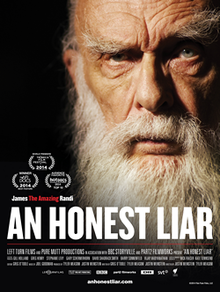
Tom G Reviews: An Honest Liar

I recently had the pleasure of watching a documentary that made a name for itself at several film festivals last year, including Tribeca. “An Honest Liar” (2014) details the life of legendary magician and skeptic James Randi, covering his career as a magician and escape artist, his homosexuality, and his decades-long mission to debunk psychics of all varieties and MO’s.
The recounting of how Randi exposed the likes of Peter Popoff, Uri Gellar, and the media’s willful blindness strike me as a the story of man who, with his intelligence and skill, could easily have become the best of the hustlers he despises, instead using his gifts to expose and educate the public about such schemes and the con men behind them. Sadly, his message of skepticism and the value of rational thought often fall on ears in deaf denial.
Well edited, but slightly shorter in length then it should be, “An Honest Liar” delivers its truth potently, as so few documentaries do. That truth is, “People believe what they need to believe”. Whether it is the public who need a healer, con artists who lie to put food on the table, or even Randi himself (I’m not giving away any spoilers); people believe in the reality they need to as a mechanism for living. And that point is what makes James Randi’s story so intriguing and so important.

I would recommend “An Honest Liar” to anyone interested in James Randi’s career or understanding man’s capacity to deceive and be deceived. 

Thursday, June 18, 2015

Helter Skelter Author Dead, But Hollywood Still Loves Charlie

Vincent Bugliosi, the man who prosecuted Charles Manson and his “Family” for the Tate-LaBianca murders in 1969, died earlier this month at 80. After going into private practice in 1972, Bugliosi wrote “Helter Skelter” an acclaimed book documenting the infamous case from start to finish. The book was adapted for the small screen twice, first in 1976 and again (less impressively) in 2004.

It’s another tick in the long timeline of the lurid case that has captivated the minds of Americans for decades. And while to most, the story of Manson and his band of murderous misfits represents a strange era, there are some even stranger people who are gripped by morbid fascination with the case and Manson himself. But now to the repellant part, there is a market for it.

Ever since Manson and his “family” exploded into the news in 1969, they have been a ready source of sales for TV, radio, newspapers, magazines, and the web. The myth of Manson attracts eyeballs. Bugliosi’s book and the movies based on it raked-in millions. In facts, it gave birth the “Serial Killer” market: a media niche that tantalizes the dark sides of those who are turned-on by it. The lurid and mysterious parts of the human experience have that magic that just sells itself. It’s attractive on a certain level.
            

The latest media dalliance with Manson Family mayhem is NBC’s primetime drama, “Aquarius” starring David Duchovny as an LAPD detective on the trail of Charles Manson in the late 1960’s. While nothing shocks me, I have to say that I was disturbed by the idea of this show. It feeds into a myth surrounding Charles Manson, portraying him as some kind of evil genius, when in reality, he was an illiterate, transient hillbilly who spent more of his life institutionalized than out and was known to have committed at least one rape at knifepoint. Less that mastermind than the marginal misfit, when the time came to make a name for himself he had young girls do his dirty work.

But worse than propping up a coward is the idea that Hollywood would exploit the deaths of six people. One of whom was eight months pregnant. Charles Manson left a lot of victims in his wake, not all of them murdered. And worse still is that there is an audience who find it entertaining. There is an audience who will probably root for Manson as an anti hero. And the fact that we live in a society that lionizes a victimizer is probably a society in trouble. 

Wednesday, April 1, 2015

Bottomed-Out by the Black Pool

           Her single light revealed the stone walls at the bottom of the labyrinth she had spent so many terrifying hours navigating. The unimaginable being that had pursued her throughout had now left her alive for reasons which she knew not, but was nevertheless grateful for. Though he had spared her life, he had not spared her eyes, or her heart… or her imagination. She now watched as her companion… the last one still left… sank slowly into the black and seemingly bottomless pool before her. She nervously fingered the black and white length of silk tied fastidiously around her neck. Her tense brown eyes locked compulsively behind the lenses of dowdy glasses on the body of a hard and good young woman sinking into nothingness.
            The walls, like the undercroft of some decrepit church or an ossuary of the dead of Paris, were lined with crude carvings. As they had descended ever deeper, the carvings had progressed into ever more horrific shapes to taunt the eye and turn her imagination against her. They were pagan and brutal. Stick men and primitive beasts with horns and multiple heads flanked gibberish writing. She feared to move her small light, for any flash against a wall might reveal another image most bewitching to burn itself into her mind where she would see only it in this darkness.
            Sitting alone, she fingered the collar of her maroon trench coat and pondered what her next move would be. She could not go back. The only way out was forward, but there was no forward, only down… into the hole… into its blackness. Still, how could she? It was still full of the water that had by now consumed her companion in whole, vanishing her like a lovebird’s penny in an artesian well.  The young woman’s mind began to fill with a terrible thought. Was this Hell? Had their escape route been a descent into an underworld from which there was no exit? A feeling began to creep over her. They had entered the maw of a nightmare. And worse yet, she was pretty sure that she was awake.
            She waited as thoughts of what had lured her into this place beyond time and reason swirled. Pushing her fine dark hair back from her face, she could look beyond the darkness and into the past; a past too agonizingly recent to forget.
            She had watched him from across the room many times, although she pretended not to. She waited for him in corridors and found reasons to buy things where he worked. Headphones, a pack of AA batteries, a power strip; all overpriced, but worth the trip just to make sure that he was there and that she might run into him by accident. She never engaged him directly, at least at first. The temptation and the possibility of absolute failure levied sheer terror on her timid heart.
            Then he came to her. Their eyes had somehow locked in the old library that fall day. He had never paid her a second thought, other than her normal and yet strikingly unusual appearance. A soft afternoon light dropped through the window on the pale, eye grabbing young woman. She seemed to glow in that way that only the Dutch masters could achieve in oil on black canvasses. He approached her and for whatever reason they hit it off. For the first time in her long time, she felt legitimately happy. It was a good day.
            One night she opened a fortune cookie and it read, “You CAN have what you want.”
            She remembered standing in a dark corridor some months later, alone. Her phone rang and she answered it. It was a text message. They knew that she would not respond, and she figured that that was the point. Somebody they both knew, he better than her, had laid it on in clear terms. He was dead.
            It was an automobile accident. Something had happened, she never learned what, but someone had slammed into someone else. He was either that someone or that someone else. She could imagine it with a near clairvoyance; the broken and twisted wreckage of an economy car like a carcass on the side of a rural road under the spread of a single, barren, diseased elm tree. His red blood squeezed from him, and spattered like paint across the grey road. His glasses, broken and twisted fell through darkness and to her feet. The shattered pieces of what she had only reached-out and touched enough to fall in love with, now before her and irreparable. She would never see him again.
            They had not spoken in some days. She imagined that it was her fault. She knew that she could be grinding on people, especially when she did not mean to. Had she said the wrong thing? Had she done the wrong thing? Made the wrong move? Most likely, yes. She knew that was what it had to be. She scared him away, and before she could tell him how she felt and why. Again, she had sabotaged herself without knowing it.
            It would be just another part of a life that she could not fit into.
            “I know why I’m here, now,” she lamented, her voice drained and quiet, “I can’t taste the future. I’m not meant to go on. I guess I belong back up there… nowhere.”
            “Are you sure?” said a voice, deep, but unspecific. She was startled to her feet by the sudden reply from nowhere and from no one.
            “The only way forward is down, through the hole.”
            “But it’s full of water,” she answered back.
            “Only because you want there to be. Your fear is what keeps you here,” explained the voice. “Beyond there is unknown, but it is not here. Through there is tomorrow.”
            The water began to drain from the hole. She watched as the slow pull grew into a flush. Soon the water was gone, and she found herself staring into blackness. She struggled to see a bottom, but she could not. Might she drown down there? Might she come-out alive? Would she simply drift in the darkness ahead? Perhaps she would land near the light of day. She did not know. She faced the black chasm of a future where nothing was impossible.
            “The only way forward in down,” said the voice.
            She pictured him waiting for her down there. Might the one she lost be there to share whatever future awaited her? She had to believe so. Her heart raced as she stepped to the edge, her cold, wet feet trembled in her boots, her thoughts fixated on his image.
            “Dream on,” said the voice in her ear.

            With that, she took a step and plunged into the hole and into whatever lay ahead. Falling down…down…down…